Monday, 5 July 2021
Spicules bring light
Wednesday, 24 February 2021
Hydra vulgaris
There are several types of Hydra that we can encounter in fresh water, for instance the Hydra Fusca, Hydra Viridis (Green Hydra) and the Hydra Vulgaris. All species have the same nutritional and environmental needs, only the appearance may differ slightly.
A hydra can have 4 to 12 tentacles with which they catch their prey and can reach a length of 3 centimeters. These tentacles are equipped with nettle cells that paralyze their prey. They can reproduce in various ways, including division. For example, if they are pulled through the middle, both parts will recover and live on.
Thursday, 4 February 2021
Tardigrades - Microscopic space travellers
Tardigrades are possibly some of the cutest and most popular microorganisms in the world. These microscopic animals can be found in all kinds of habitats all over the planet from high mountains to deep oceans, and even on the poles. However, even though they are very common almost everywhere you will need a microscope to spot them as most species are around 500 microns in size and the biggest ones rarely exceed 1 mm. Tardigrades are more commonly known as water bears, because of their bear-like appearance when they waddle around in the microworld looking for food. Some also call them moss piglets because of their high abundance in moss and lichen samples.
Tuesday, 21 July 2020
A better image for your stereo microscope
In stereo microscopy, a 3D image from a 3-dimensional sample is our ambition. Different viewing angles for both eyes create different images on the retina of the left and the right eye. Our brain is going to process both images. This concept is best comprehensible in the Greenough construction of a traditional stereo microscope: two complete separate beam paths from objective to the eyes, mounted in a relative angle of 11°-16°. But even in the modern, more flexible CMO (Central Main Objective) concept a different viewing angle is realized.
Wednesday, 25 March 2020
Yeast - The helpful and harmful organism
Yeasts are unicellular fungi that mainly metabolism sugars for energy. They are very common in the wild where they can be found on the skins of fruit and other sugar-rich places like cereal grain crops. Even though yeast plays a huge role in many aspects of our everyday lives, most species are only about 4 microns in diameter, which is about half the size of our red blood cells. in comparison, a single human hair is roughly 80 microns thick.
Wednesday, 11 March 2020
Tardigrades - Some of the toughest, and smallest, animals on earth!
Wednesday, 18 July 2018
Surface structures easily revealed
Thursday, 6 October 2016
Feather facts
Feathers are incredibly strong and yet are incredibly flexible. To allow both lift and forward movement, feathers can bend at almost a right angles.
Monday, 1 August 2016
Introduction to Darkfield illumination - Slider solution
Dark field emphasizes borders and isolated, single structures, flagella of protozoa and tiny particles. The comparison of a diatom sample in bright field and dark field clearly shows this:
How such an image is achieved? We need to eliminate the direct light which ordinarily passes the specimen and which is responsible for the bright background in bright field illumination. For objectives with a Numerical Aperture ≤ 0.65 this
Monday, 18 July 2016
The microscope objective - the key issue for best image performance
The microscope objective is an even more specific item. Here we talk about the required resolution power (= numerical aperture), but also about cover glass correction, immersion method and working distance.
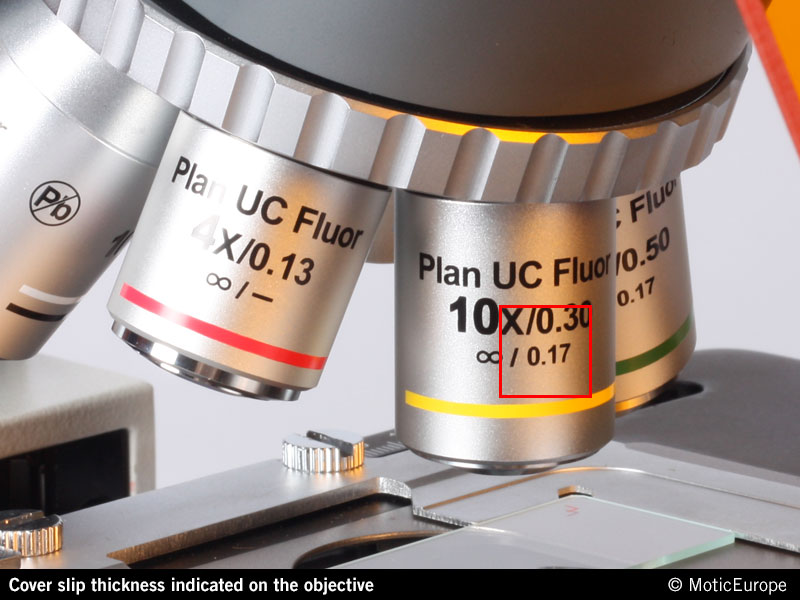
1. The standard upright microscope for transmitted light is constructed for glass slides with a 0.17mm cover slip. This restriction is indicated on the objective sleeve:
![]() |
| Cover slip thickness indicated on Motic's Plan UC Fluor objectives |
The cover slip has to be placed on top of the sample. A slight pressing of a dissecting needle will help to avoid too much embedding medium (water, etc.) between sample and cover slip. The embedding medium in this case works as an