Showing posts with label phase contrast. Show all posts

Wednesday, 22 January 2020

Phase contrast - You always got a sample with you


Phase contrast is a widespread method in transmitted light microscopy. Especially in biology and medicine with their native samples this contrast method often is the easiest way to examine thin, unstained sections, smears and emulsions with almost no absorption.

The necessary hardware for Phase contrast 
  • Figure 1: Objective with evaporated phase ring
  • Figure 2: Illumination slot
  • Figure 3: Centering telescope
  • Figure 4: Phase ring


An objective with an evaporated Phase ring is combined with a respective illumination slot, placed in the focal plane of the condenser. The Centering telescope is a helpful tool to bring the round illumination ring to a perfect overlap with the partly transparent Phase ring. 

How to use the Phase Contrast accessories

Friday, 29 September 2017

Quick microscope setup guide for Life Sciences inverted microscopes

SWITCH ON THE MICROSCOPE

Plug-in the microscope to the power supply (1). Switch it on (2) and gradually increase the light intensity up to the desired level (black wheel on the right side of the microscope) (3).


Monday, 18 July 2016

The microscope objective - the key issue for best image performance

Different samples require different microscopes. This rule refers to the fact that an opaque, bulky sample with a reflective surface needs another treatment than a transparent, unstained smear from the cavitas oris. The microscope stand offers the necessary space for a correct positioning of the sample and all options for the appropriate illumination method.

 The microscope objective is an even more specific item. Here we talk about the required resolution power (= numerical aperture), but also about cover glass correction, immersion method and working distance.

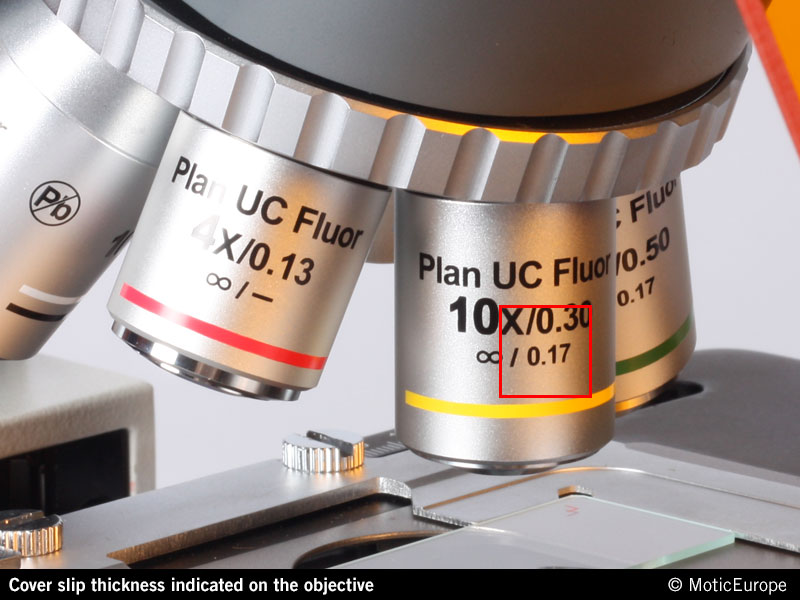
1. The standard upright microscope for transmitted light is constructed for glass slides with a 0.17mm cover slip. This restriction is indicated on the objective sleeve:

Cover slip thickness indicated on Motic's Plan UC Fluor objectives


The cover slip has to be placed on top of the sample. A slight pressing of a dissecting needle will help to avoid too much embedding medium (water, etc.) between sample and cover slip. The embedding medium in this case works as an

Monday, 2 May 2016

Euglenophyta


These organisms are unicellular and live in fresh water. Some of these organisms are photosynthetic, producing their own food, while others are heterotrophic, eating small organisms.

Euglena acus

The Euglena (genus) acus (species) is a type of Protista which lives in fresh water ponds during warm seasons. The Euglena acus produces its food through